How do you fit two decades of Roblox into one event?
Thousands of top games, millions of creators, billions of play sessions, and trillions of chat messages. That's a lot of history to bring together in one experience.
That was the challenge we took on when we set out to build The Hunt: Roblox 20 for Roblox's 20th anniversary.
We wanted to give players a chance to revisit some of the most memorable moments in Roblox history. The hard part? Figuring out which moments we could include, how to bring them together, and how to make the experience feel authentic to players. It's one thing to look back at 20 years of Roblox—it's another to recreate it.
For a team that's spent years building on Roblox, this was something different. We weren't just making another experience. We were celebrating the platform that helped shape our own journey.
We caught up with members of the Twin Atlas team to talk about how Roblox 20 came together, the creative decisions, the challenges, and what it meant to be part of such a big milestone.
Where Do You Even Start?
The first step was going down a very deep Roblox history rabbit hole.
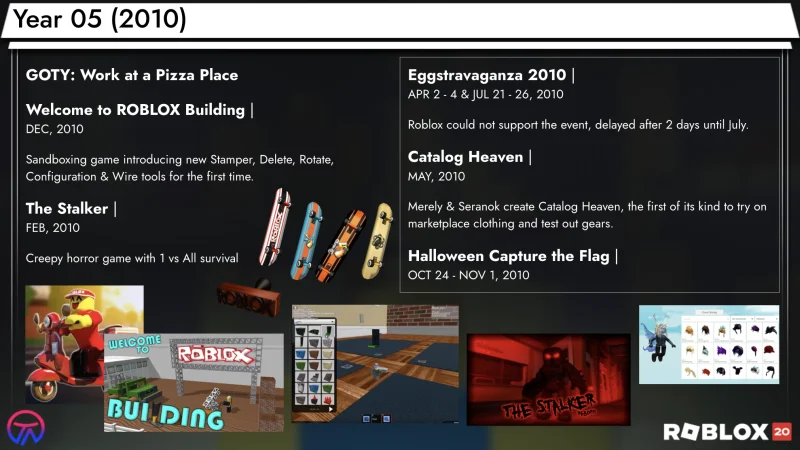
The team started by researching each year of Roblox, pulling together the games, trends, and cultural moments that made each era memorable. From there, they built a master planning deck to map out what each year could look like.
People across the studio pitched in, sharing memories, suggesting games, and flagging the moments they felt deserved a place in the experience.
Andrew Bereza, Business Development Director: “My first experience on Roblox was just messing around with build mode. You know, dragging free models, zombies, cars, all the fun stuff. I knew I wanted to make games on Roblox since I was 9 years old.”
Once the team had a direction, the planning was shared with Roblox and the real work of bringing those ideas to life began. Each year needed its own identity, with a distinct art style, details, easter eggs, and references that players could recognize.
The goal was to show players what Roblox looked like over the years and to give them a reason to stop and look around. To see how far we’ve come and to relive the shared moments.
Every Era Has Its Own Identity
One of the biggest challenges was making sure each year actually felt like its own moment in Roblox history.
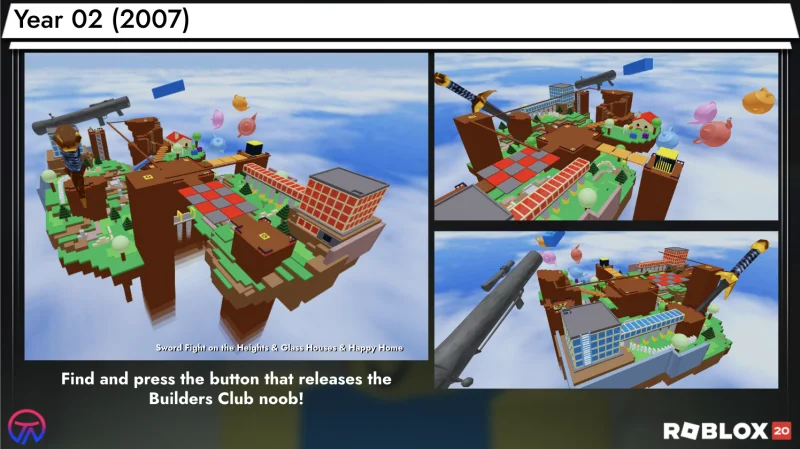
Roblox in its early days looks nothing like Roblox today. The games, visuals, building tools, and overall feel of the platform have changed dramatically. Capturing those differences meant paying attention to the details, not just recreating a few familiar environments.
Faithfully recreating older versions of Roblox meant going further than simply matching the visuals. For the 2012 era, one of our environment artists tracked down an older version of Roblox Studio, allowing them to export the original smooth terrain geometry and bring it directly into Roblox 20. Rather than approximating what the terrain used to look like, the team was able to work with the original geometry itself, preserving a piece of Roblox's history down to the details.
Mary Rukavina, Creative Director: “My first Roblox memory was back in 2013 on YouTube where I’d always see those ‘IT’S FREE!’ ads. I got my account set up and I was playing those early Build To Survive and disaster games.”
Those personal memories are part of what made the project so interesting. Everyone has a different starting point with Roblox, and we hope that the experience brings many of those different eras together in one place.
The Stuff You Don't See
A project spanning 20 years of Roblox history comes with a lot of moving parts.
Every map needed to capture the look and feel of its respective era, while still working as part of one larger experience. The team had to bring the research and planning into the actual game, build out the environments, and make sure players could move through the experience and engage with each year.
That idea became a big part of the experience. Rather than simply reading about Roblox history, players got to explore it themselves. They got to play the past.
And with so many years, maps, and details coming together, collaboration across the team was essential. There was a lot to build, a lot to get right, and plenty of little details that players might only notice if they knew what they were looking for.
A Full-Circle Moment for Twin Atlas
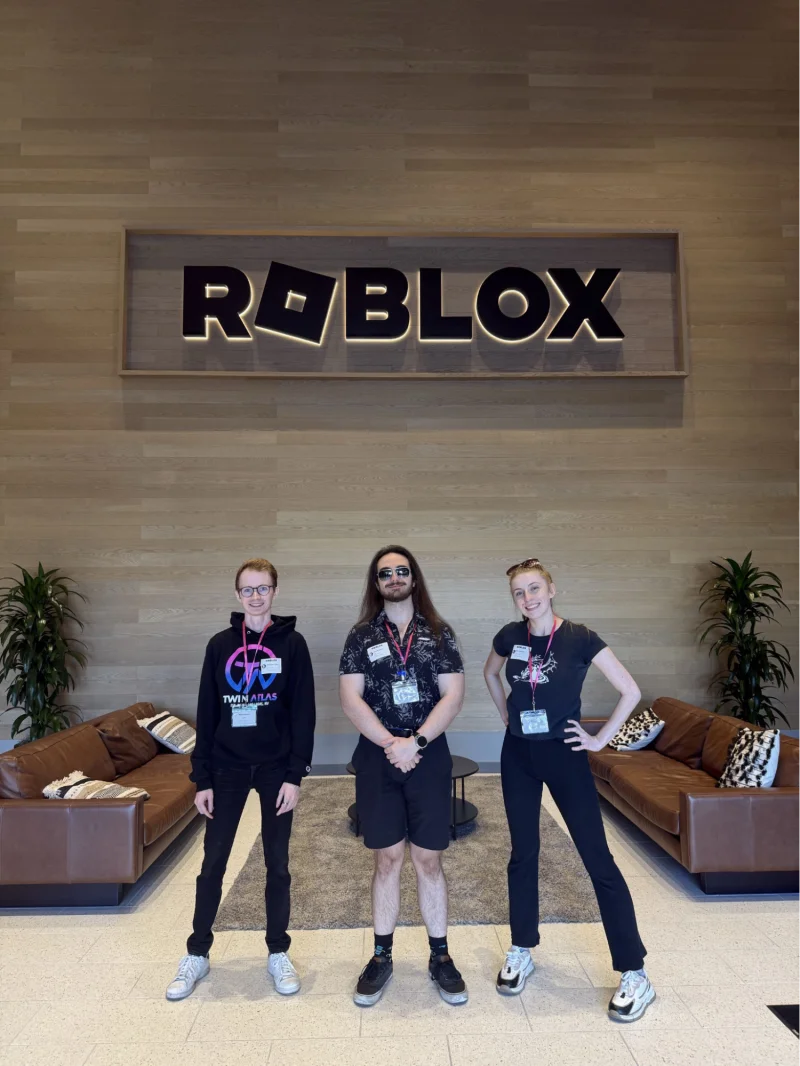
There's another reason this project meant so much to the team: Roblox history is intertwined with our own history.
Before Twin Atlas, the teams behind Sonar Studios and RedManta were building their own games and communities on the platform. Both studios grew independently before coming together in 2022 to form Twin Atlas.
So the people working on Roblox 20 weren't just looking back at a platform they knew. They were looking back at the place where their careers began and where they built the studios that eventually became Twin Atlas.
Alex Hicks, Creative Director, co-founder of RedManta: “RedManta and Sonar were very similar companies. When we met, we had similar goals where we wanted to build high quality games on Roblox and we wanted to do it with a group of developers that were raised on the platform.”
Now, years later, Twin Atlas was being trusted to build an experience celebrating that same platform's 20-year history. It's hard to think of a more full-circle project.
20 Years Down, What's Next?
The Hunt: Roblox 20 ran from September 17 through September 28, giving players a limited-time chance to travel through two decades of Roblox history.
For the Twin Atlas team, the project was an opportunity to step outside of our own games for a moment and look at the much bigger platform we've been a part of for years.
Twenty years of Roblox can't really be summed up in one experience. There are too many games, creators, communities, and stories to fit into a single timeline.
But that was never really the point.
The goal was to give players a chance to revisit some of those moments, discover pieces of Roblox they might have missed, and remember why those experiences mattered in the first place.
And for Twin Atlas, getting to build that journey was a pretty special way to celebrate the platform that helped get us here.